Switch
Key Ideas#
Change is hard. To execute change, leaders have to act differently and motivate their teams to act differently. This book details a framework to effect change.
Elephants and Riders#
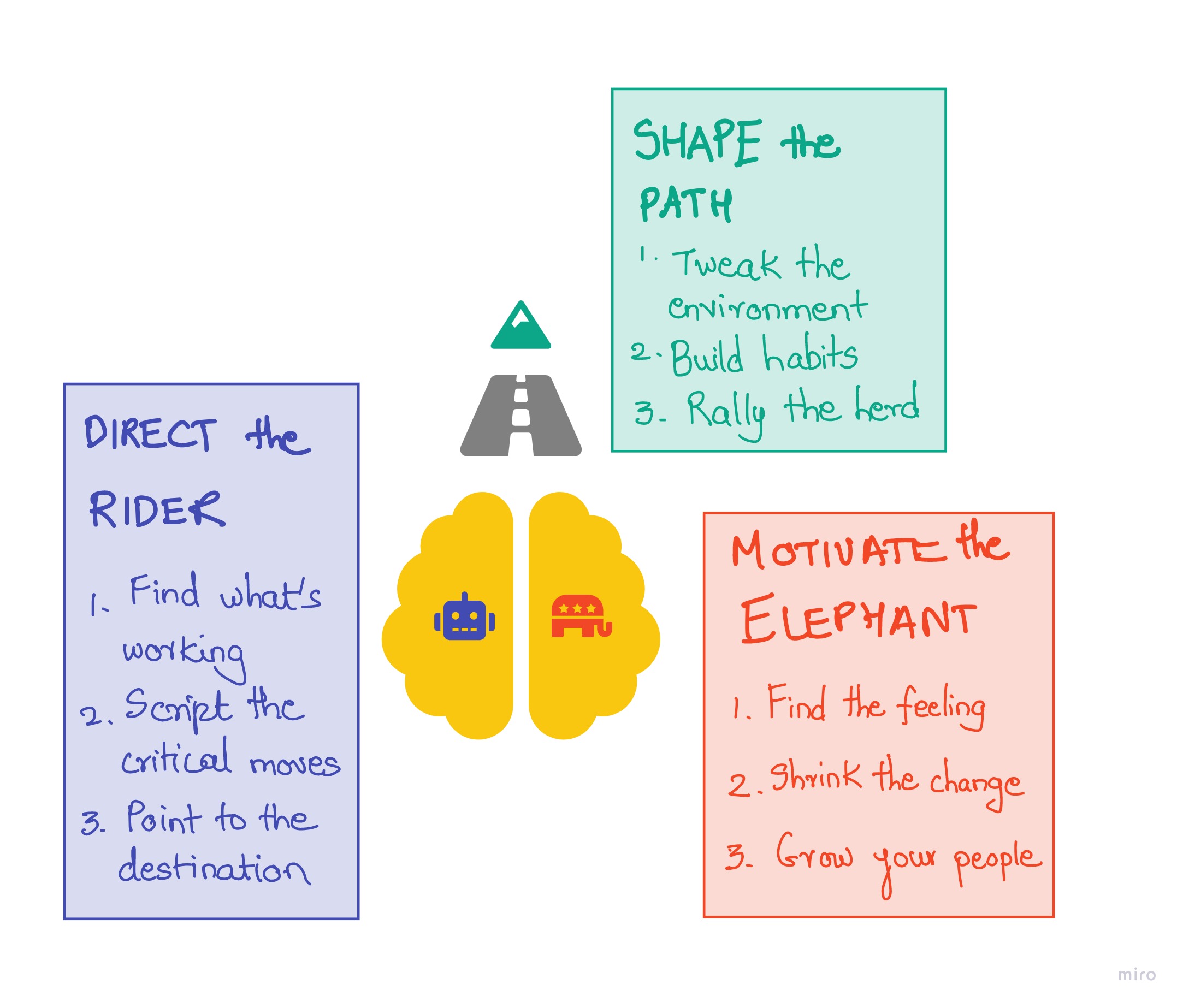
Based on Jonathan Haidt’s work, the authors describe how each person has an emotional Elephant side and a rational Rider side. What motivates one does not help with the other. To effect change, you must appeal to both the Elephant and the Rider.
Directing the Rider#
- Find what’s working. Instead of focusing on problem analysis, find the thing that is working, and clone it. Follow the bright spots.
- Script the critical moves. Find a series of small, but pivotal, steps to change, and script them. The critical part is important: else you are unsustainably scripting everything.
- Point to the destination. Create a Big, Hairy, Audacious Goal [[BHAG]] or a Destination Postcard. These do double duty by showing the Rider where you’re headed and show the Elephant why the journey is worthwhile.
Motivate the Elephant#
- Find the feeling - rational logic isn’t enough; make people feel something viscerally. People think the sequence is ANALYZE-THINK-CHANGE but in reality, for most big changes, the sequence is SEE-FEEL-CHANGE.
- Shrink the change - break down the change until it not scary or demoralizing. Every large change starts with a small change, make that change a small win.
- Grow your people - cultivate a sense of identity and instill a growth mindset.
Shape the Path#
- Tweak the environment - change the situation instead of changing the behavior.
- Build habits - look for ways to encourage habits rather than banking on motivation.
- Rally the herd - behavior is contagious. Help it spread.
Other interesting ideas#
Prefer to use positive emotion to motivate, vs. scaring people or using negative emotion such as the Burning Platform Memo (choice between a fiery death or a cold sea and shark food.)
The Haddon Matrix is a simple framework that provides a way to think systematically about accidents by highlighting three key periods of time:
- Pre-event interventions include things that would prevent. wrecks from happening - installing bright lighting on highways, painting clear lane markers on the roads.
- Event interventions will accept that crashes will happen and ask how we can reduce the changes of injury. Seat belts and air bags.
- Post-event interventions acknowledge that both crashes will happen and people will get injured. Minimize the severity of injuries and optimize the health outcomes - speedy emergency crews, jaws of life.
The Checklist is a great tool to accomplish two things at once: 1) tweaking the environment and 2) building habits.